
-
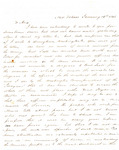
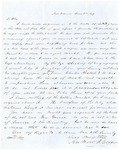
Letter: Andrew Jackson Coffee to Alexander D. Coffee, 1848
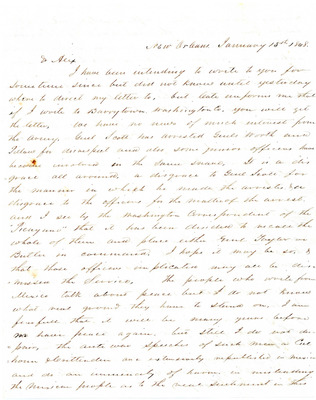
Letter from Andrew Jackson Coffee, New Orleans, Louisiana, to Alexander Donelson Coffee, near Barrytown, Alabama, written on January 15, 1848.
Andrew reports that General Scott arrested Generals Worth and Pillow for disrespect as well as some junior officers. He states: “It is a disgrace all around, a disgrace to Genl Scott for the manner in which he made the arrests & a disgrace to the officers for the matter of the arrest…” He heard that they might be replaced with General Taylor or Butler in command. He does not believe there will be peace in Mexico soon. He blames the anti-war speeches of John C. Calhoun and George Crittenden that are republished in Mexico. He hopes that once the presidential candidates are selected, the United States will present a united front on Mexico. He and Betty had another son, to be named Andrew Jackson. Notes the flood of the Tennessee impacted Alex’s cotton fields somewhat and an enslaved person on the Hutchings estate named Peter drowned. Reports that the cotton market is not good.
-
Letter: Andrew Jackson Coffee to Alexander D. Coffee, 1849
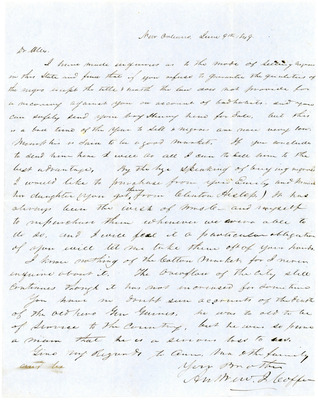
Letter from Andrew Jackson Coffee, New Orleans, Louisiana, to Alexander Donelson Coffee, no location given, written on June 9, 1849.
Andrew notes that Louisiana only requires proof of the title and health of enslaved people and there is no provision for recovery on account of bad habits. Thus, Alex could sell his enslaved person Henry there but warns prices are low at this time of year. Suggests Memphis as a good market but will help Alex if he does decide to sell in New Orleans. Wants to buy Alex’s enslaved people Emily and her daughter Munch(?), whom Alex bought from Clinton Heslep. He mentions the death of General Edmund P. Gaines in New Orleans: “He was to [sic] old to be of service to the country, but he was so pure a man that he is a serious loss to us.”
-
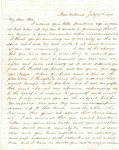
Letter: Andrew Jackson Coffee to Alexander D. Coffee, 1850
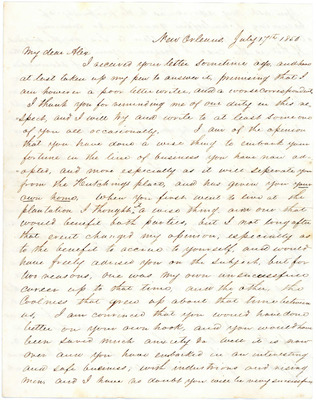
Letter from Andrew Jackson Coffee, New Orleans, Louisiana, to Alexander Donelson Coffee, no location given, written on July 17, 1850.
Andrew congratulates Alex on his new “interesting and safe business” [cotton mill]. He comments on Alex taking the guardianship of John Donelson Coffee, Jr., suggesting that it would be troublesome and maybe better if John’s mother (Mary Narcissa Brahan Coffee) retains the guardianship and management of his property. He says the death of President Taylor has upset things and hopes the new president will support the compromise over slavery, predicting civil war since the South will “have little mercy to expect from the North.” He thinks the Texas boundary question ought to be settled by giving Texas “her rights”. He and Betty had another son.
-
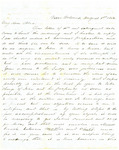
Letter: Andrew Jackson Coffee to Alexander D. Coffee, 1852
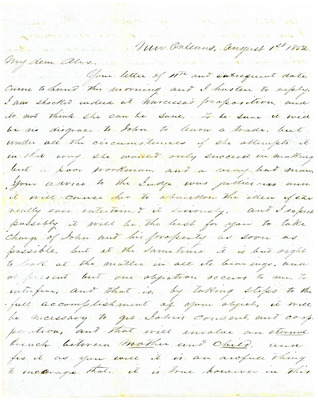
Letter from Andrew Jackson Coffee, New Orleans, Louisiana, to Alexander Donelson Coffee, no location given (Florence, Alabama), written on August 1, 1852.
Andrew notes the continued issue of John Donelson Coffee, Jr.’s future and the dispute with his mother Narcissa. He thinks Alex should take legal charge of John and his property for the boy’s sake although it may lead to an “eternal breach between mother and child.” Andrew also notes that since he hopes to move house, he does not need to sell his enslaved people (Martha and her children, Bundy and John Henry) to Alex. If he sells them, it will be done in New Orleans. He and Betty had their fourth son.
-
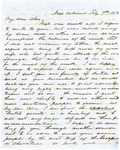
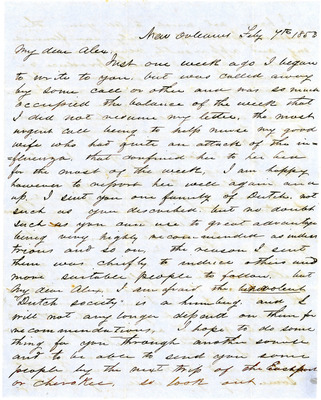
Letter: Andrew Jackson Coffee to Alexander D. Coffee, 1853
Letter from Andrew Jackson Coffee, New Orleans, Louisiana, to Alexander Donelson Coffee, Florence, Alabama, written on February 7, 1853.
Andrew has sent some “Dutch” (German) people to Alex for work. Notes they may not be exactly as Alex wanted but they are industrious and he hopes that will induce others to follow. The “benevolent ‘Dutch Society’” recommended them but he will not be dealing with it again, calling it “a humbug”. Says New Orleans is very prosperous and the “railroad spirit is abroad”. He hopes that he can soon travel back to Florence by rail “without all the labor and loss of time now necessary to do so.” Urges Alex to build a new house on a site which is more conducive to his health.
-
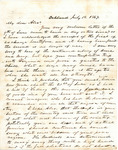
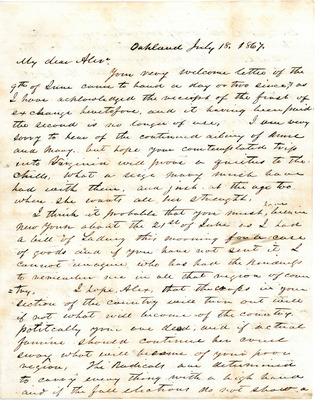
Letter: Andrew Jackson Coffee to Alexander D. Coffee, 1867
Letter from Andrew Jackson Coffee, Oakland, California, to Alexander Donelson Coffee, no location given (Florence, Alabama), written on July 18, 1867.
Andrew mentions national and California politics. His daughter Kate has a daughter. Kate’s husband, Charles McDougal, has been ordered to take his ship, U.S.S. Jamestown, up to Sitka for the transfer of the newly purchased Alaskan territory.
-
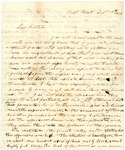
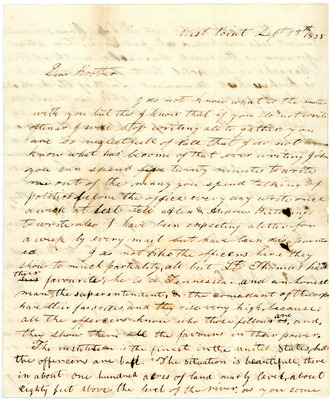
Letter: Andrew Jackson Coffee to John D. Coffee, 1835
Letter from Andrew Jackson Coffee, West Point Military Academy, to his brother John D. Coffee, Florence, Alabama, written on September 13, 1835.
Andrew does not like the officers at West Point because they have favorite cadets, apart from Lt. Thomas from Tennessee. “The institution is the finest in the United States, but the offircers [sic] are bad.” He describes the layout of West Point in some detail and asks John to visit him there in the summer.
-
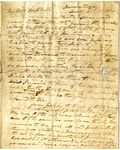
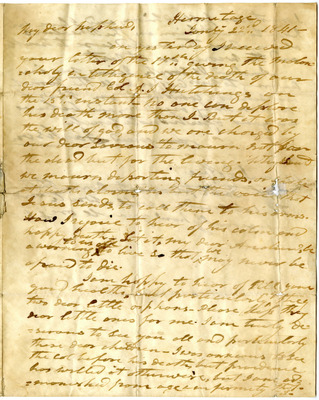
Letter: Andrew Jackson to Andrew Jackson Coffee, 1841
Letter from Andrew Jackson, Hermitage, Tennessee, to Andrew Jackson Coffee, near Florence, Alabama, dated January 22, 1841.
Jackson laments the death of his adopted son, Colonel Andrew Jackson Hutchings. Noting it is the will of God, he states: “How I rejoice to hear of his calm and happy death – Let it, my dear Andrew, be a warning to us all to live so that we may never be afraid to die.” He suggests that because of his age he will soon follow his son.
-
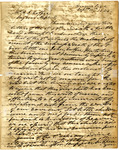
Letter: Andrew Jackson to Andrew Jackson Coffee, 1844
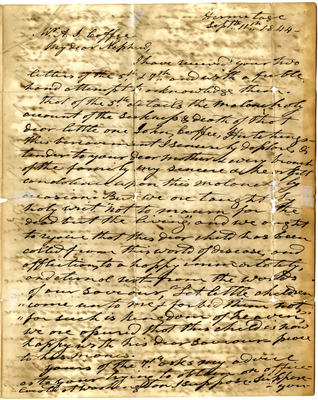
Letter from Andrew Jackson, Hermitage, Tennessee, to Andrew Jackson Coffee, near Florence, Alabama, dated September 11, 1844.
Jackson expresses his sadness at the death of John Coffee Hutchings, the son of his former ward, Andrew Jackson Hutchings, and Mary Coffee Hutchings. Says that instead of mourning “…we ought to rejoice that this dear child has been called from this world of disease, and affliction, to a happy immortality and eternal rest…” He advises Coffee not to seek office in Washington because he would not make enough money to support his family and the sedentary life would only bring him disease and death. Jackson recommends he seek new land under the preemption laws and build a farm to ensure the safety of his family. He states that he would help him to get an office if he thought it would not be destructive to Coffee and his family, or if he was still single.
-
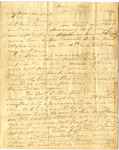
Letter: Andrew Jackson to Andrew Jackson Hutchings, 1840
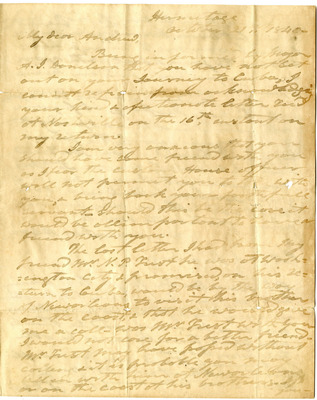
Letter from Andrew Jackson, Hermitage, Tennessee, to Andrew Jackson Hutchings, near Florence, Alabama, dated October 21, 1840.
Jackson expresses concern that Hutchings does not have a companion on his voyage to Cuba. He suggests that he might get Mr. N. E. Feist(?) to accompany him. He wishes him a pleasant journey. Tells about talking to Dr. Doyle about Hutchings’ son John who has had a problem with his vison that is improving. He thanks Hutchings for completing a contract with Mr. Parker. He asks that Hutchings tell Andrew Jackson Coffee that either Jackson or his son will be at the plantation on the Mississippi in December to receive him.
Hutchings (1813-1841) was the grandson of Jackson’s wife’s sister, Catherine, whose parents died in 1817, and a former ward of Jackson, who married Mary Coffee (1812-1839).
-
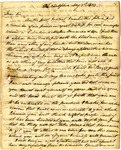
Letter: Andrew Jackson to John Coffee, 1804
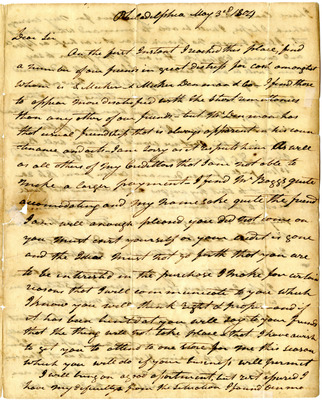
Letter from Andrew Jackson, Philadelphia, Pennsylvania, to John Coffee, Haysborough (near Nashville), Tennessee, dated May 3, 1804.
Jackson is concerned about the lack of cash to pay his creditors. He tells about a supply of goods he is getting for his store and talks of a partnership with Mr. Hutchings. If it does not work out, he has another venture planned for Coffee and himself. He requests that this letter be destroyed.
-
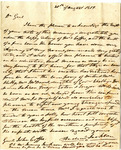
Letter: Andrew Jackson to John Coffee, 1819
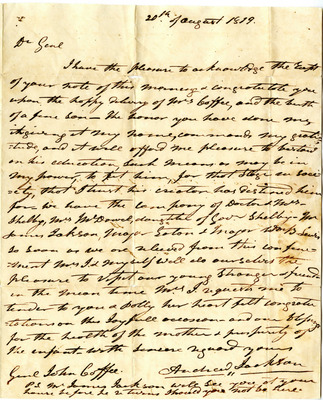
Letter from Andrew Jackson to John Coffee dated August 20, 1819.
Jackson congratulates Coffee on the birth of a son and thanks him for giving the baby his name. He offers to help the boy with his education. A transcription is included.
-
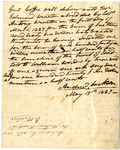
Letter: Andrew Jackson to John Coffee, 1827
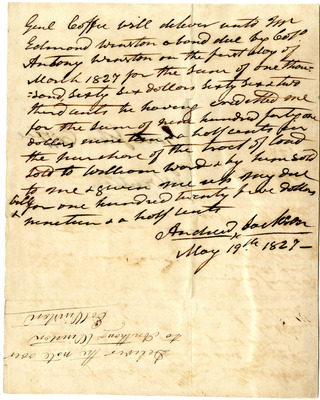
Letter from Andrew Jackson to John Coffee dated May 19, 1827.
Jackson asks Coffee to deliver a bond to Edmond Winston for a tract of land purchased by William Ward and then by Jackson.
-
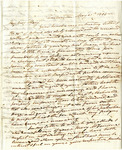
Letter: Andrew Jackson to Mary Coffee, 1833
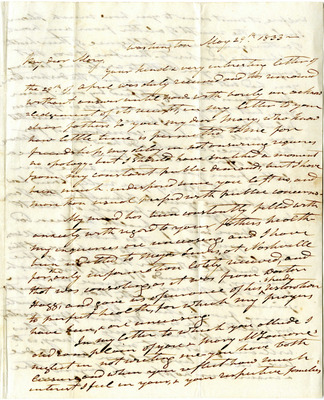
Letter from President Andrew Jackson, Washington, D.C., to Mary Coffee (daughter of John Coffee) dated May 29,1833.
Jackson notes the burdens of his office. He expresses his concern about the health of Mary’s father and says that his own health has been bad but is improving.
-
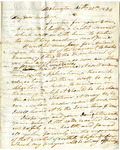
Letter: Andrew Jackson to Mary Coffee, 1834
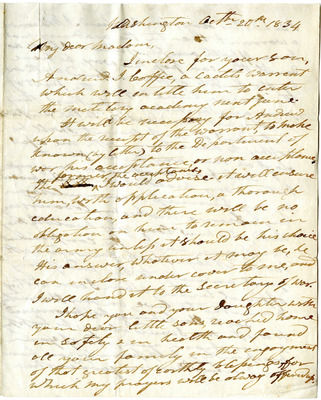
Letter from President Andrew Jackson, Washington, D.C., to Mary Donelson Coffee (wife of John R. Coffee), near Florence, Alabama, dated October 20, 1834.
Jackson sends a cadet's warrant for her son, and his namesake, Andrew Jackson Coffee, to enter the U.S. Military Academy and advises him to accept admission: “…it will ensure him, with application, a thorough education, and there will be no obligation on him to remain in the army unless it should be his choice. His answer, whatever it may be, he can inclose [sic] under cover to me, and I will hand it to the Secretary of War.” He has also sent a warrant to a nephew of his wife, Andrew J. McLemore. He looks forward to seeing both young men in Washington and spending some time with them before they report to West Point. Jackson will be glad when his presidential term is up and he can return to the Hermitage. He asks Mary to tell Andrew Hutchings (Jackson’s former ward and husband of her daughter Mary) to write to him.
-
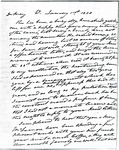
Letter: Andrew Jackson to Mary Eastin, 1830
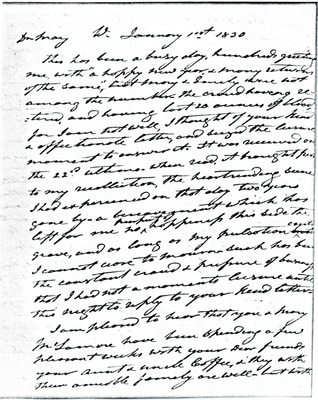
Copy of a letter from President Andrew Jackson, Washington, D.C., to Mary Eastin, Near Fountain of Health (near Nashville), Tennessee, dated January 1, 1830. (The year recorded by Jackson is incorrect: the letter was written in 1831.)
Jackson is not feeling well and records it is two years since his wife died. Notes Mary had visited her aunt and uncle, John and Mary Donelson Coffee. Talks about past rumors and slanders that caused his wife’s niece, Emily Donelson, and her husband Andrew to split with Jackson. He is willing to again be friends with Mr. Ingham and his family and Governor Branch if they agree to it. He wants Mary and Emily to return to Washington and for Emily to resume acting as First Lady.
A transcription is included.
The background to this letter is discussed in Crawford, Charles W., "This Subject is a Painful One to Me", Tennessee Historical Quarterly, 26:1, 1967 Spring, pp.59-63.
-
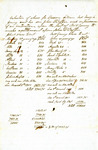
List of enslaved people belonging to Mary Brahan Coffee, 1850
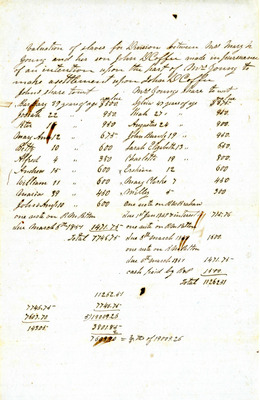
List of enslaved people owned by Mary Narcissa Brahan Coffee (1817-1893), widow of John Donelson Coffee (1815-1837), just before her marriage to Dr. James Young in 1850, and their valuations. This was one of several documents prepared in Panola County, Mississippi. The property was to be divided between Mary’s son, John D. Coffee, Jr., to be put in trust, and her brother, John Coffee Brahan, who will control the other part on Mary’s behalf. Included in the property were the following enslaved people:
John Coffee’s share: Barbary, 39 years old; Josiah, 22; Peter, 17; Mary Ann, 12; Betty, 10; Alfred, 4; Andrew, 15; William, 11; Maria, 39; John Amp, 10.
Mary Coffee’s share: Sylvia, 47; Kiah, 27; Augustus, 24; John Bundy, 19; Sarah Elizabeth, 13; Charlotte, 19; Erskine, 12; Mary Clarke, 7; Milley, 5.
-
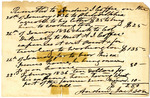
Memo: Andrew Jackson, 1836
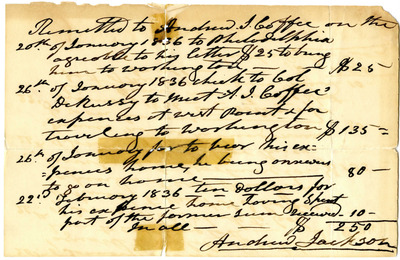
Memorandum by President Andrew Jackson, dated January-February 1836, that is a statement of payments totaling $250 for Andrew J. Coffee to go to Washington and then to West Point, and then to return to Philadelphia.
-
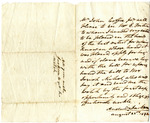
Note: Andrew Jackson to John Coffee, Jr., 1832
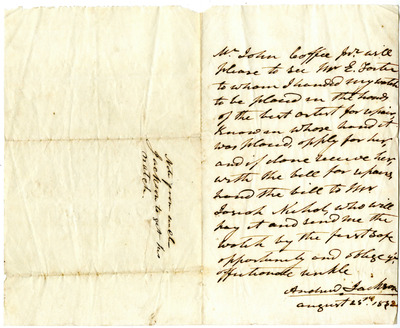
Note from President Andrew Jackson to John Coffee, Jr., dated August 25, 1832.
Jackson asks Coffee to find out to whom Mr. E. Foster gave Jackson’s watch for repair, to get the watch and bill, and to give the bill to Josiah Nichol who will pay for it and send him the watch. A transcription is included.
Printing is not supported at the primary Gallery Thumbnail page. Please first navigate to a specific Image before printing.