
-
Letter: Peter Taylor to Nadine Parker, 1941
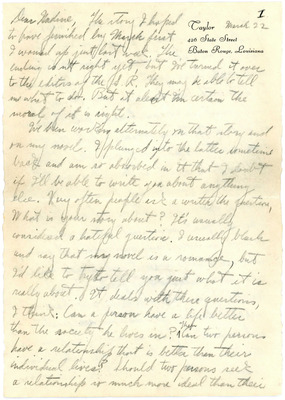
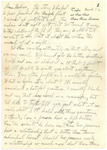
Letter from Peter Taylor, Baton Rouge, Louisiana, to Nadine Parker, Memphis, Tennessee, dated March 22, 1941. Has finished the draft of a story that he has sent to the Southern Review. He has also been working on a novel and then spends much of the six-page letter discussing it.
-
Letter: Peter Taylor to Nadine Parker, 1941
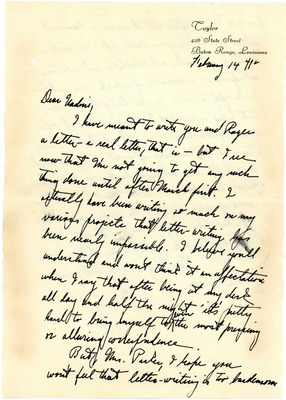
Letter from Peter Taylor, Baton Rouge, Louisiana, to Nadine Parker, Memphis, Tennessee, dated February 14, 1941. Notes he has been writing a lot so that letter writing is "nearly impossible". Asks Nadine to write about her daily life "so rich as it is in human relationships and cultural enterprise... I'm starving for the taste of sweet gossip, absurd argumentation, intimate Sunday-night suppers, carousing evenings in West Memphis, and an occasional whiff of the rare, rank odor of Memphis High Society. ‘Though I fly to Baton Rouge, still I am a Memphis stooge.’”
-
Letter: Peter Taylor to Nadine Parker, 1941
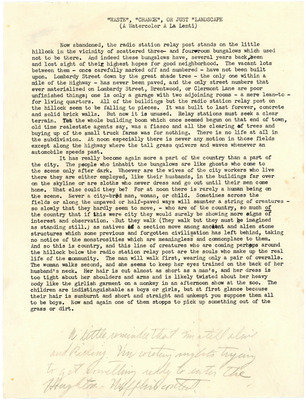
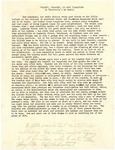
A piece of writing sent by Peter Taylor, Fort Oglethorpe, Georgia, to Nadine Parker, Memphis, Tennessee, postmarked September 22, 1941. The piece is titled "Waste”, “Change”, or Just “Landscape (A Watercolor a la Lenti). In a hand-written note at the bottom, he says he is trying to write something for the Houghton-Mifflin contest.
-
Letter: Peter Taylor to Nadine Parker, 1941
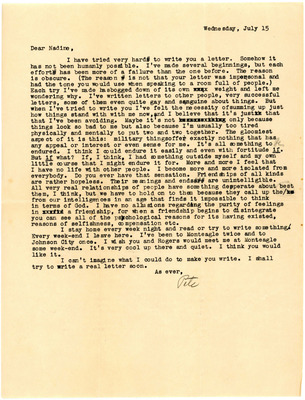
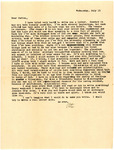
Letter from Peter Taylor, Fort Oglethorpe, Georgia, to Nadine Parker, Memphis, Tennessee, dated July 15, 1941. Reflects on his army life: "Military things offer exactly nothing that has any appeal or interest or even sense for me. It’s all something to be endured."
-
Letter: Peter Taylor to Nadine Parker, 1941
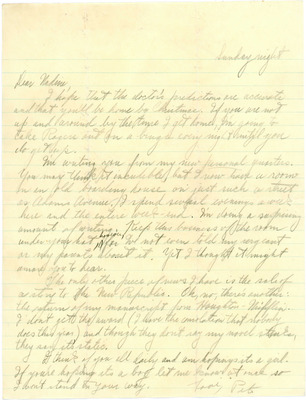
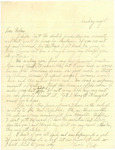
Letter from Peter Taylor, Fort Oglethorpe, Georgia, to Nadine Parker, Memphis, Tennessee, postmarked December 1, 1941. Notes that he has taken a room in an old boarding house as his "personal quarters" where he spends several evenings and the weekend writing. He has sold a story to the "New Republic", but Houghton-Mifflin has returned another manuscript of his.
-
Letter: Peter Taylor to Nadine Parker, 1941
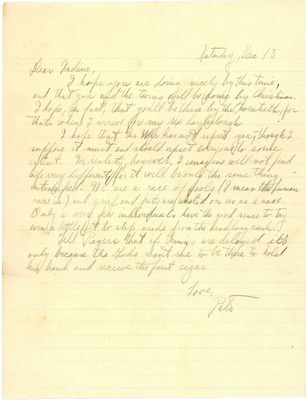
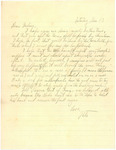
Letter from Peter Taylor, Fort Oglethorpe, Georgia, to Nadine Parker, Memphis, Tennessee, dated December 13, 1941. He hopes the war will not impact Nadine. "We are a race of fools (I mean the human race is) and grief and pity are wasted on us as a race." Referring to Nadine's pregnancy, he writes: "Tell Rogers that if things are delayed it's only because the Gods want me to be there to hold his hand and receive the first cigar."
-
Letter: Peter Taylor to Nadine Parker, 1942
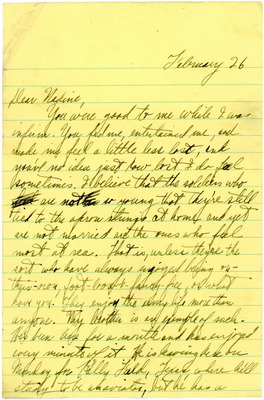
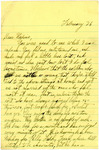
Letter from Peter Taylor, Fort Oglethorpe, Georgia, to Nadine Parker, Memphis, Tennessee, dated February 26, 1942. Contains his reflections on soldiers and the suspension of the Southern Review. "I had to write Red Warren recently about the end of the Southern Review, and I told him that it seemed to me necessary for such a magazine to continue publication (if only for the duration of the war). For if our good literary magazines have to close down when we enter a war, it means that we just barely do have a culture at all. But precious little everybody thinks about such things any more. Maybe it’s right that they don’t, but for a great, civilized nation the situation stinks. In what way is our culture really better than the German or the Japanese?”"
-
Letter: Peter Taylor to Nadine Parker, 1943
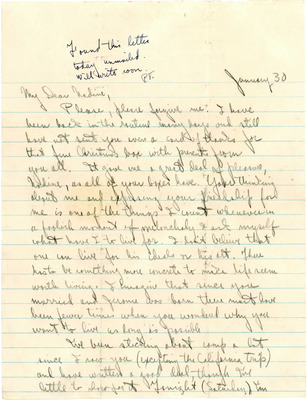
Letter from Peter Taylor, Fort Oglethorpe, Georgia, to Nadine Parker, Memphis, Tennessee, dated January 30, 1943. Taylor thanks Nadine for Christmas box. “I don’t believe that one can live for his ideals or his art. There has to be something more concrete to make life seem worth living. I imagine that since you married and Jerome was born there must have been fewer times when you wondered why you want to live as long as possible.” Reports he has published a poem in Mademoiselle magazine.
-
Letter: Peter Taylor to Nadine Parker, 1944
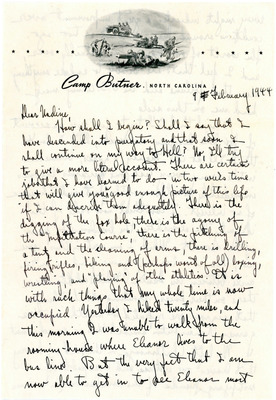
Letter from Peter Taylor, Camp Butner, North Carolina, to Nadine Parker, Memphis, Tennessee, dated February 9, 1944. Describes army training at Camp Butner and that his wife Eleanor is close by. States that he will be going overseas: "I am eager for experiences which I may have, especially if we go to the European theatre. I am frightened at the thought of actual combat in which there is, of course, a chance of my taking part. And I am distraught at the prospect of leaving Eleanor,…"
-
Letter: Peter Taylor to Nadine Parker, 1944
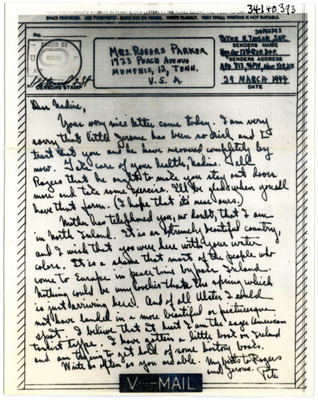
Letter from Peter Taylor, Northern Ireland, to Nadine Parker, Memphis, Tennessee, dated March 29, 1944. “It is an extremely beautiful country, and I wish that you were here with your water colors. It is a shame that most of the people who come to Europe in peace time bypass Ireland...And of all Ulster I could not have landed in a more beautiful or picturesque spot. I believe that at heart I am the eager American tourist type."
-
Letter: Peter Taylor to Nadine Parker, 1945
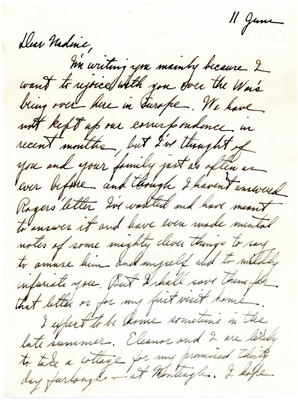
Letter from Peter Taylor, stationed with the U.S. Army in the United Kingdom, to Nadine Parker, Memphis, Tennessee, dated June 11, 1945. Describes visits to London, especially to the art galleries; discusses his own religious beliefs as “some sort of Catholic”, and Anthony Trollope. “The nineteenth century, I’m convinced, was the great age of genius.”
-
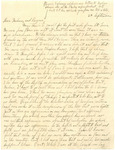
Letter: Peter Taylor to Nadine Parker, 1945
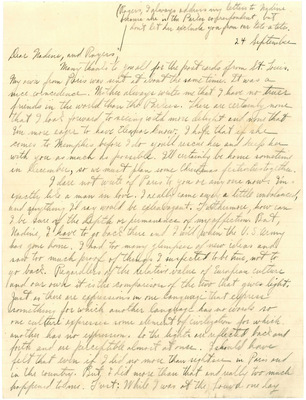
Letter from Peter Taylor, stationed with the U.S. Army in the United Kingdom, to Nadine Parker, Memphis, Tennessee, dated September 24, 1945. Notes his love of Paris where he talked with Gertrude Stein, and, as a result, reflects on European and Southern culture: "…I am almost ready to say that it was not the Civil War which prevented the development of a real Southern culture. It was slavery. It is the presence of the negro race which has prevented us from developing our own peasantry or class of small farmers." Also mentions what he has been reading, including St. Augustine and Rousseau.
-
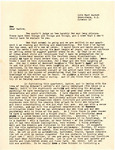
Letter: Peter Taylor to Nadine Parker, 1946
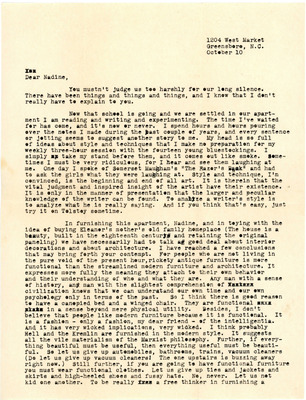
Letter from Peter Taylor, Greensboro, North Carolina, to Nadine Parker, Memphis, Tennessee, dated October 10, 1946. Writes about his teaching and writing; "Style and technique, I'm convinced, is the beginning and end of all art. It is therein that the vital judgment and inspired insight of the artist have their existence. It is only in the manner of presentation that the larger and peculiar knowledge of the writer can be found. To analyze a writer’s style is to analyze what he is really saying. And if you think that’s easy, just try it on Tolstoy sometime." Comments on furnishing an apartment and his distaste for the modern style; asks if the Parkers know Allen Seager whose story Taylor likes.
Printing is not supported at the primary Gallery Thumbnail page. Please first navigate to a specific Image before printing.